
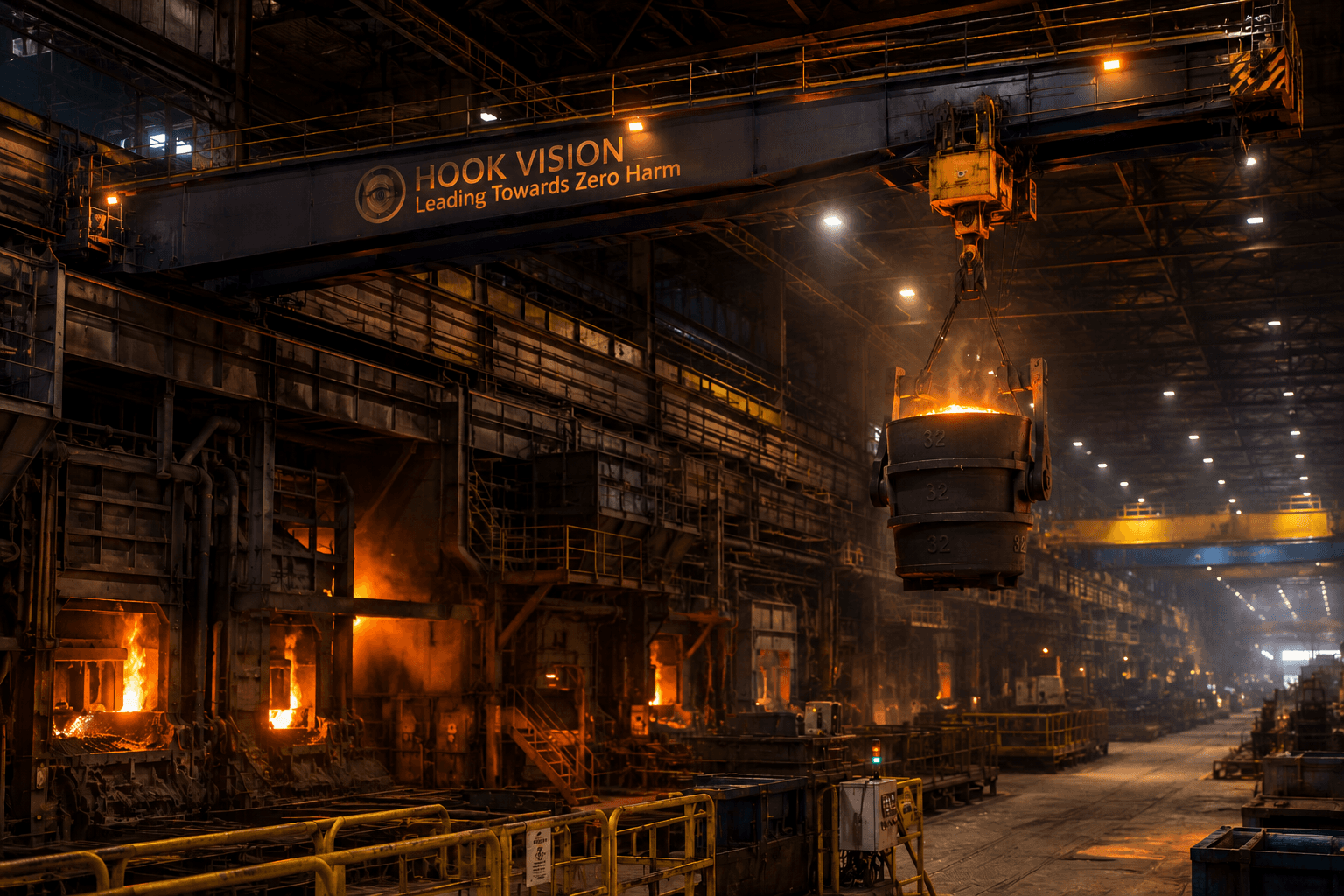
HookVision
In developmentA tireless second set of eyes on the crane operator's own view — one that never tires, never looks away, never grows complacent on a long shift. Vision-led collision protection for overhead ladle and process cranes, added to an in-service crane without touching its control system.
The Thesis
It does not replace the operator. It covers the one thing people are worst at.
HookVision augments the single weakness of an alert, experienced operator: sustained, unbroken attention on a rare event. Its value is continuity of attention — not superiority of perception.
The operator is the safest element in the bay
An alert operator sees through glare that defeats a camera, moves their head to see around obstructions, and brings judgement no machine has. The design starts here: the operator is the primary safety layer.
Collisions live in the attention gap
They rarely happen because a good operator cannot see. They happen in the gap where attention lapses — fatigue late in a shift, a glance away, the complacency of the ten-thousandth identical lift. That gap is exactly where a machine is strong.
A machine does not fatigue and does not look away. That is the gap HookVision stands in.
Risk, Not Distance
It evaluates risk — where the hook is, where it is heading, and what is near it.
Conventional anti-collision measures distance to fixed, pre-mapped structures. That is partial: it ignores the changing scene, and the way an oscillating load occupies far more space than its resting position. HookVision maintains a protective envelope that moves with the hook and changes shape with the situation.
Speed lengthens it
The faster the hook moves, the more room is needed to bring it and its load to a stable stop — so the envelope reflects the braking distance in the direction of travel.
Swing widens it
An oscillating load sweeps far more space than its resting position suggests. Swing is treated as part of collision risk — the envelope grows to cover the path the load can swing into.
Low confidence grows it
When fume, glare, or a fouled lens degrade the picture, the envelope is sized more cautiously rather than asserting a precision it does not have.
The System
Three cabin cameras. One radar. One edge computer. Nothing from the crane.
The complete sensing set — and no more. It is a true retrofit: the system needs nothing from the crane to perform its safety function, so it is added to an in-service crane without modifying its control system.
Perception
Three cabin cameras
A compact, factory-aligned bar at the driver cabin, viewing along the bay in overlapping near / mid / far focal bands. The cameras do all perception — hook tracking, load and swing, foreign objects, risk.
Handoff
One crab radar
A single 1D radar on the crab measures one quantity — crab range — so the system always knows which focal band owns the hook. Handoff is deterministic, not a camera guessing its own range at a band boundary.
Compute
One edge computer
On-board, ingests the synchronised camera streams and radar range, runs perception and safety logic in real time, drives the cabin warnings, and records every event with video for playback and review.
| Band | Optics | Role |
|---|---|---|
| Near | Wide field | Holds the hook and the area beneath it when the crab is close to the cabin. |
| Mid | Primary tracking | Carries continuous hook tracking through the central span of crab cross-travel. |
| Far | Long focal length | Keeps the hook and rope at high resolution when the crab is at the far end of the bay. |
Why the radar is robust
The radar ranges the crab — a large, rigid, slow-moving structure on a single constrained axis, and it does not swing. It proposes which band is active; the cameras confirm by actually detecting the hook. An occasional erroneous reading results, at worst, in a momentarily less-than-ideal camera continuing to track — never in a safety-relevant error.
Independence
Independent in how it senses. Optional in how it connects.
Because the safety function depends on nothing from the crane, HookVision retrofits to an in-service crane with no change to its control system.
Required — supplied with the system
- Three fixed cabin cameras (factory-aligned, frame-synchronised)
- One 1D crab-mounted radar
- One on-board edge computer
- Power and a stable cabin mounting point
Not required from the crane
- Crane PLC signals
- Encoders or position feedback
- Laser or radar rangefinders
- RFID or any existing anti-collision system
- Any change to the crane control system
Perception & Safety Logic
From three streams to a warning in time to act.
The pipeline runs in real time at the edge. It supports the operator's judgement rather than flooding the cabin with alarms — clear, graded signals, every event recorded with video.
Acquire & synchronise
Three frame-synchronised camera streams plus the 1D crab range are ingested at the edge.
Band selection
Radar range proposes the active focal band; the cameras confirm by detecting the hook — deterministic handoff.
Hook & load tracking
The hook is tracked continuously; load motion and swing amplitude are estimated from the scene.
Foreign-object detection
People, vehicles, ladles, equipment, and obstructions are detected within the working scene.
Envelope & risk
A dynamic protective envelope is sized around the hook; incursions are scored as collision risk.
Graded warning & logging
Visual and audible signals are raised in time to act; every event is recorded with video.
Warnings are operationally meaningful
Integration
Advisory by design.
Where a plant wishes, HookVision shares information with existing systems — dashboards, event logging, crane and drive interfaces — for visualisation and record-keeping.
In its delivered form this connection is advisory only: the system informs and warns; it does not take control of the crane. The operator remains the primary safety authority and makes the decision. Any move beyond advisory operation would be a separate, explicitly agreed step.
In the Plant
When the picture degrades, it gets more cautious — not less.
The design addresses the hard conditions of a real bay explicitly: varying and low light, dust and smoke, hot-metal glow, reflections, motion blur, and lens contamination — held with high-dynamic-range imaging and adaptive exposure.
Graceful degradation as a safety property
Rather than asserting confidence it does not have, the system continuously estimates how reliable its own picture is and carries that confidence into the safety logic. Heavy fume, a fouled lens, a moment of glare — the response is to widen its caution and make the reduced confidence visible to the operator.
A firm line between learning and deciding
Recognition — detecting the hook, the load, and foreign objects — improves in service as difficult cases are reviewed and incorporated. The safety logic itself — the thresholds that define risk and size the envelope — changes only through reviewed, versioned, validated updates. The system does not quietly relax its own protection.
Operating Envelope
Where it is strong, and where the operator stays in the lead.
Stated plainly, as a matter of engineering discipline — so the system is trusted because its limits are known, not in spite of them. None of these is a reason not to deploy.
Operator-primary by design
The system assists the operator's viewpoint; it is not a substitute for their perception or judgement. It warns; the operator decides and acts.
Vision-based sensing
Distance and scale are read from the scene rather than a dedicated ranging sensor. Where confidence falls, the system signals it rather than asserting precision.
Extreme visibility loss
In conditions that would also impair the operator — dense fume, severe glare — the picture degrades. The response is to widen caution and make it visible.
Stable mounting
Accurate operation depends on the cameras' fixed cabin position. The system checks its own alignment against fixed features and flags drift rather than silently tolerating it.
One Engine, Over Time
Anti-collision is what ships. The same perception engine is a foundation for more.
The capability delivered today is anti-collision protection. The following are future, separately scoped stages — noted only to indicate direction. None is part of the delivered system, and any that would act on the crane would be a distinct, explicitly agreed programme.
Predictive collision avoidance and richer operator guidance
Rope and load-condition monitoring from the same camera views
Anti-sway position assistance, building on the envelope's precision
Digital-twin and fleet-wide analytics across multiple cranes
HookVision is the machine half of crane safety — the operator half runs through our crane-fatigue work: geometry, cognition, and the load, instrumented together.